
Neural DSP Quad Cortex
floor format FX modeler / profiler
Quad-core processing for complex guitar and bass rigs
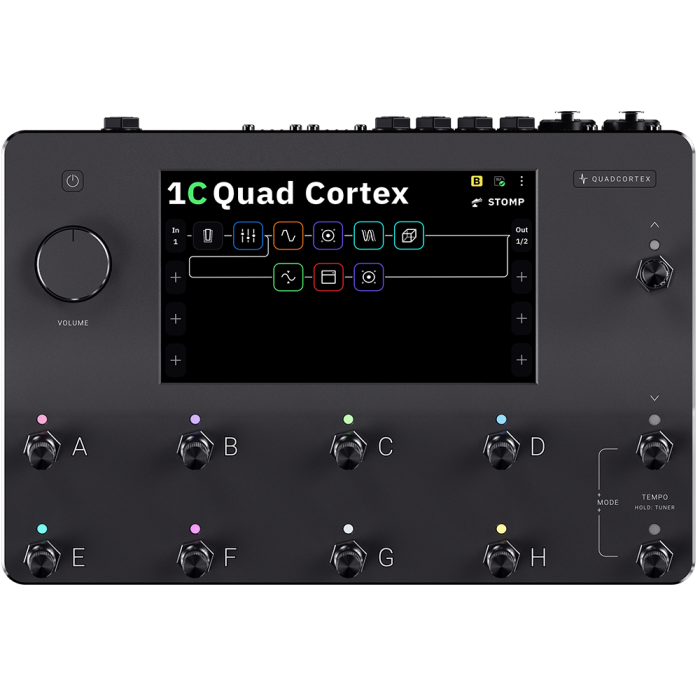
7" touchscreen with 11 rotatable footswitches
Neural Capture V1 and V2 for amps, cabinets, and pedals
90+ amps, 100+ effects, and extensive routing
CorOS 4.1.0 with new Virtual Devices and expanded plugin compatibility
Want to know when this item is back in stock? Send us your email address and we'll notify you as soon as it's available!
Our product experts are happy to help you!
The Neural DSP Quad Cortex is a floorboard processor for guitarists and bassists that combines amp modeling, effects, Neural Capture, and extensive routing in a single system. Designed for use on stage, in the studio, and at home, the processor offers enough processing power to run multiple amps, cabinets, effects, and signal paths simultaneously.
The Quad Cortex features four SHARC+ processors and two ARM processors. This allows you to build complex rigs with multiple amps and effects without needing several separate processors. The system runs on Neural DSP CorOS and is expanded with new features, effects, and improvements via firmware updates.
Out of the box, the Quad Cortex includes over 90 amp models, more than 100 effects, and over 1,000 cabinet IRs. You can also use Neural Captures and import your own impulse responses.
CorOS 4.1.0: New Effects and Plugin Compatibility
Neural DSP continues to expand the Quad Cortex via CorOS. CorOS 4.1.0 is a major update that adds new Virtual Devices, additional plugin compatibility, and new features for managing rigs.
CorOS 4.1.0 adds support for five additional X-updated Neural DSP plugins:
- Archetype: John Mayer X
- Archetype: Petrucci X
- Archetype: Misha Mansoor X
- Archetype: Rabea X
- Archetype: Tim Henson X
Together, these plugins provide more than 70 additional amps, cabinets, and effects that can be used within the Quad Cortex. To use the devices from a plugin, you must have a valid license for the corresponding Neural DSP plugin. With CorOS 4.1.0, the Neural DSP plugins that have currently received an X update are compatible with the Quad Cortex platform.
Eight New Virtual Devices for Every User
CorOS 4.1.0 also adds eightnew Virtual Devices that are available to all Quad Cortex users:
- Multivoicer
- Glitch
- Ring Modulator
- Arpeggio Delay
- Crystal Delay
- Vintage Digital
- Douglas Shining Comp
- Plugin Parametric-4
Multivoicer can add up to four pitch-shifted voices and is suitable for harmonies and arpeggios. Glitch uses granular delay for rhythmic and experimental sounds. Arpeggio Delay combines delay with different pitches, while Crystal Delay can create pitch-shifted repeats. Vintage Digital adds digital reverb sounds, and Douglas Shining Comp further expands the system’s compression capabilities.
Device Presets for a Faster Workflow
CorOS 4.1.0 introduces Device Presets. This means you don’t always have to save an entire Quad Cortex preset when you just want to reuse a specific setting. For example, you can save a favorite amp setting, compressor, overdrive, delay, or cabinet configuration as a Device Preset and then load it into other rigs. Neural DSP includes over 2,000 Factory Device Presets with CorOS 4.1.0. In addition, you can save up to 32 of your own Device Presets for each supported Virtual Device. Device Presets can also be used for I/O Settings and Global EQ. This allows you, for example, to save separate settings for home, rehearsal, studio, and live performance. CorOS 4.1.0 also introduces Dual Footswitch Assignment for supported devices. This allows you to assign a second function of a Virtual Device—other than the bypass function—to a different footswitch. The Favorites and Recent sections have also been updated. Presets, Neural Captures, and Impulse Responses now have separate categories, each capable of holding up to 64 items.
Cortex Control for Mac and Windows
With Cortex Control, you can control and manage the Quad Cortex from a Mac or Windows computer. This allows you to build rigs on a larger screen and organize presets, Captures, IRs, and other settings. Cortex Control 4.1.0 also supports Multiple Device Management. When multiple Quad Cortex or Quad Cortex Mini processors are connected to the same computer, you can switch between these devices from within Cortex Control. Device Presets, I/O Settings Presets, and Global EQ Presets can also be managed from within Cortex Control.
[[READMORE]]
Neural Capture V1 and V2
A key feature of the Neural DSP Quad Cortex is Neural Capture. This allows you to capture the tonal characteristics of real guitar and bass amplifiers, cabinets, and effects pedals and then use them as digital blocks within your own rig. Neural Capture V1 is processed directly on the Quad Cortex and works without an internet connection. It’s suitable for amplifiers, cabinets, overdrive pedals, and more, and creates a Capture in just a few minutes. Neural Capture V2 uses Cortex Cloud for processing and employs a higher-resolution algorithm. This allows the characteristics of dynamic gear to be captured more accurately. Think of how an amplifier responds to your playing style, sag, transients, compression, and the smoothing out of an overdriven sound when you turn down the volume on your guitar. V2 is particularly useful for gear where dynamics play a key role in the sound, such as tube amps, fuzz pedals, and compressors. A Neural Capture is placed as a separate block on The Grid. This allows you, for example, to combine a Capture of an amplifier with a different cabinet, your own IR, or the Quad Cortex’s built-in effects.
7" touchscreen and 11 rotary footswitches
The Quad Cortex is controlled via its 7" multitouch display and 11 stainless-steel footswitches. These footswitches also function as rotary knobs. When you select an amp, effect, or other Virtual Device, the corresponding parameters can be adjusted directly using the rotary footswitches. This allows the Quad Cortex to combine touchscreen control with physical controls. The signal chain is displayed on The Grid. Here, you can place and move amps, cabinets, Neural Captures, effects, inputs, outputs, splitters, and other blocks. This also allows for more complex setups with multiple parallel signal paths. The Quad Cortex supports Preset, Scene, Stomp, and Hybrid Modes. This allows you to tailor the controls to how you want to switch between settings during a performance. Preset Mode provides access to complete rigs, while Scene Mode lets you recall different settings within the same preset. In Stomp Mode, the footswitches function more like the individual pedals on a traditional pedalboard. Hybrid Mode combines different control methods. For use on stage, there’s Gig View, which displays the most important information large and clearly on the screen.
Cortex Cloud and Wi-Fi-
The Quad Cortex features built-in Wi-Fi and works with Cortex Cloud. Here you can find, share, and download presets and Neural Captures. This also allows you to use Captures from other Quad Cortex users. This makes it possible to add new amp and pedal sounds to your own collection without having to capture them yourself. Cortex Cloud is also used for backups and for Neural Capture V2. Firmware updates can be installed on the Quad Cortex via Wi-Fi.
8-in/8-out USB audio interface The Quad Cortex can be used directly as an audio interface for Mac and Windows via USB. The system supports 24-bit audio at 48 kHz and features eight USB inputs and eight USB outputs. This allows you to record processed stereo signals directly into your DAW, as well as capture a dry DI signal separately. That dry signal can later be sent back to the Quad Cortex to reroute the recording through a different amp, Capture, or a complete preset. These re-amping capabilities make the Quad Cortex suitable as a central processor within a studio setup without requiring a separate audio interface for every application.
Extensive Connectivity Options
The Quad Cortex features two combined XLR/6.35 mm TS/TRS inputs. Both inputs have built-in microphone preamps, adjustable impedance and gain, and support for phantom power. This allows you to connect not only guitars and basses, but also microphones. This is particularly useful when you want to mic an amplifier and cabinet to create a Neural Capture. There are two effects sends and two effects returns available for placing external pedals and other processors within the signal chain. The routing for these can be configured per preset. For connection to a PA system, mixer, FRFR speaker, or studio equipment, there are two balanced XLR outputs and two balanced 6.35 mm TRS outputs. In addition, the Quad Cortex features a 6.35 mm headphone output, two 6.35 mm TRS expression inputs, MIDI In and MIDI Out/Thru via standard 5-pin DIN connectors, and a separate Neural Capture Output. The extensive routing capabilities also make it possible to process multiple instruments simultaneously. For example, two musicians can each use their own input, amp, effects, and output within the same Quad Cortex.
Looper X, tuner, and metronome
Looper X is built into CorOS and can be placed on The Grid as a Virtual Device. The looper’s position determines which part of the signal chain is recorded. The looper features functions such as Record, Overdub, Play/Stop, Undo/Redo, Reverse, Half Speed, One Shot, Duplicate, and Punch In/Out. Quantize, MIDI Clock synchronization, pre-roll, and an adjustable fixed loop length are also included. Because the Quad Cortex has eight A-H footswitches, the most important Looper X functions can be controlled directly from the floorboard. In addition, a tuner and metronome are integrated into CorOS.
Compact aluminum floorboard enclosure
Despite the number of connections and controls, the Quad Cortex remains relatively compact. The housing is made of anodized aluminum, and the 7" display is protected by 1.8 mm tempered glass. The Quad Cortex measures 29 x 19.5 x 6.9 cm and weighs 1.95 kg. This makes it suitable as a standalone pedalboard, but it can also be integrated into a larger pedalboard setup. The power supply operates on 12 V DC and must deliver at least 3 A with center-negative polarity. A compatible power supply is included.
Neural DSP Quad Cortex features:
- guitar and bass processor with amp modeling, effects, and Neural Capture
- four SHARC+ processors and two ARM processors
- 7" multitouch display
- 11 stainless steel rotary footswitches
- over 90 amp models
- over 100 effects
- over 1,000 cabinet IRs
- Support for Neural Capture V1 and Neural Capture V2
- Support for custom impulse responses
- Four signal paths for extensive and parallel routing
- Preset, Scene, Stomp, and Hybrid modes
- Gig View for use on stage
- up to 3,072 user presets
- Up to 2,048 user Neural Captures
- Up to 2,048 user IRs
- Plugin Compatibility for supported Neural DSP X plugins
- CorOS 4.1.0 with additional plugin compatibility and new Virtual Devices
- Support for Archetype: John Mayer X, Petrucci X, Misha Mansoor X, Rabea X, and Tim Henson X
- Eight new Virtual Devices via CorOS 4.1.0
- Over 2,000 factory device presets via CorOS 4.1.0
- Up to 32 User Device Presets per supported Virtual Device
- Device Presets for Virtual Devices, I/O Settings, and Global EQ
- Dual Footswitch Assignment for supported devices
- Cortex Control for Mac and Windows
- Cortex Cloud for presets, Neural Captures, IRs, and backups
- Built-in Wi-Fi
- 8-in/8-out USB audio interface
- 24-bit / 48 kHz USB audio
- Support for re-amping via USB
- Looper X with Record, Overdub, Reverse, Half Speed, and Quantize
- Built-in tuner and metronome
- 2x XLR / 6.35 mm TS/TRS combo inputs
- Built-in microphone preamps and phantom power
- 2x 6.35 mm effects return
- 2x 6.35 mm effects send
- 2x balanced XLR outputs
- 2x balanced 6.35 mm TRS outputs
- separate Neural Capture Output
- 1x 6.35 mm stereo headphone output
- 2x 6.35 mm TRS expression inputs
- MIDI In and Out/Thru via 5-pin DIN
- MIDI via USB
- Anodized aluminum housing
- Display protected by 1.8 mm tempered glass
- Power supply: 12 V DC / minimum 3 A, center-negative
- power adapter included
- Dimensions: 29 x 19.5 x 6.9 cm
- weight: 1.95 kg
| Brand | Neural DSP |
|---|---|
| Ean Code | 748367937415 |
| Color | Grijs |
| Tap-tempo | yes |
| Stereo input | yes |
| Stereo output | yes |
| Analog | no |
| Effect type | Multi effect pedaal |
| Buizen | No |
| Number of Footswitches | 8 or more |
| Touchscreen | yes |
| Amp Modelling | yes |
| Master Outputs | XLR & 1/4" jack |
| Effects loop | yes |
| Expressie input | yes |
| Midi connector | USB & DIN |
| Article number | 71426 |
| Size (packaging) | 50 cm x 30 cm x 20 cm |
Eerste kennismaking met CorOS 4.1.0 voor Quad Cortex en Quad Cortex Mini
CorOS 4.1.0 is a free update for all Quad Cortex and Quad Cortex Mini users. The biggest CorOS update to date adds a total of more than 80 devices, including devices from five newly compatible plugins. In addition, CorOS 4.1.0 introduces Device Presets, a major improvement for building and managing rigs more quickly.
From discovering new sounds and building presets to preparing for a performance, the update is designed to help you spend less time on setup and more time playing.

 Blog
Blog
Dat verschillende houtsoorten een andere klank produceren is waarschijnlijk niet nieuw voor je. Maar wat voor klank bij welke houtsoort hoort, dat leggen we je graag even uit!
Read more in our blog