
Strymon Timeline MX
multi-delay and reverb
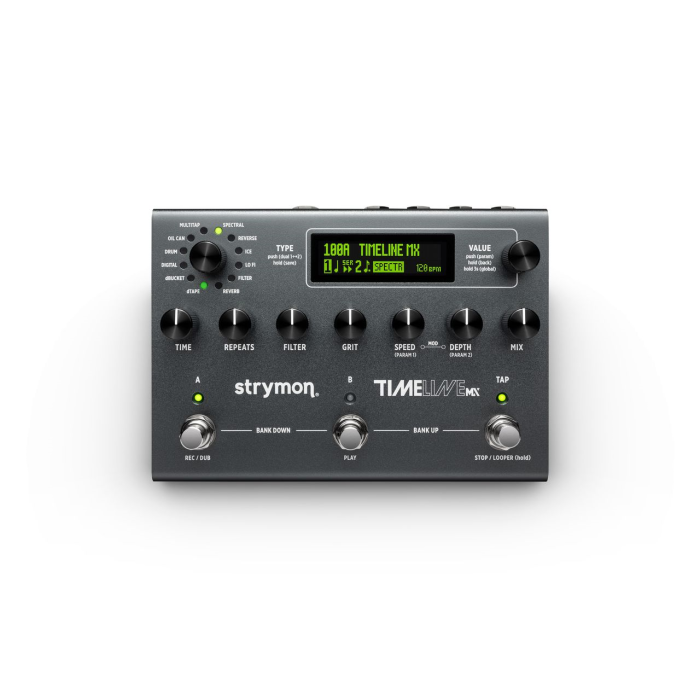
Strymon's Flagship Delay
Tri-core 800 MHz ARM processor
12 high-quality delay engines
Two effects at once (Dual Engine)
Built-in 5-minute stereo looper
Want to know when this item is back in stock? Send us your email address and we'll notify you as soon as it's available!
Our product experts are happy to help you!
The Strymon TimeLine MX takes delay to a whole new level. This powerful multi-delay pedal combines studio-quality sound, unprecedented processing power, and intuitive controls in a single rugged enclosure. From warm vintage echoes to futuristic soundscapes and complex rhythmic delays, the TimeLine MX inspires with every note.
With twelve high-quality delay engines, an all-new reverb engine, and the ability to use two effects simultaneously, the TimeLine MX is an all-in-one solution for guitarists, keyboardists, and producers who refuse to compromise.
Key features:
- 12 high-quality delay engines
- New integrated reverb engine
- Two effects simultaneously (Dual Engine)
- Series, Parallel, or Split routing
- Stereo inputs and outputs plus stereo Send/Return
- Built-in 5-minute stereo looper
- Full MIDI support via USB-C, TRS, and DIN
- 800 MHz tri-core ARM processor
- 24-bit / 96 kHz audio
- Analog dry path with zero latency
- True Bypass or Buffered Bypass
- Two effects at once
[[READMORE]]
One of the biggest innovations of the TimeLine MX is the ability to use two effect engines simultaneously. For example, combine:
- two different delays
- delay and reverb
- two rhythmic patterns
- stereo soundscapes
The effects can be routed in Series, Parallel, or Split modes, with each engine panned independently to create a wide stereo image.
New Reverb Engine
In addition to the eleven delay engines, the TimeLine MX features a completely new reverb engine. From subtle room simulations to vast ambient soundscapes with long decay times: everything sounds exceptionally rich and natural. The reverb also features:
- adjustable Grit for extra warmth and overdrive
- optional Tremolo on the wet signal
- adjustable speed and depth
This allows the TimeLine MX to effortlessly function as a complete delay and reverb solution.
12 Delay Machines
- dTape: Authentic tape echo with adjustable wow and flutter, tape saturation, crinkle, and extensive tape characteristics.
- dBucket: Warm bucket-brigade delay with natural modulation and classic analog degradation.
- Digital: Multiple digital delay sounds, ranging from crystal-clear modern to characterful ’80s rack units. Available modes: 24/96 Studio, ADM, 12-bit, Classic TimeLine
- Drum delay: Recreation of classic drum echoes with multiple playback heads, natural instability, and organic modulation.
- Oil Can: Dark, floating vintage echo with characteristic modulations and unpredictable repeats.
- Multitap: A completely new 8-tap delay that makes it easy to create complex rhythms and stereo patterns. Adjust settings per tap, including level, feedback, pan, filter, and timing
- Spectral: An all-new granular delay engine that breaks the incoming signal down into small fragments. Add pitch shifting, reverse, filters, or time stretching for experimental and atmospheric textures.
- Reverse: Play a phrase and hear it play back perfectly in sync in reverse.
- Ice: Granular pitch-shifting delay with intervals ranging from one octave down to two octaves up.
- Lo-Fi: Add bitcrushing, sample rate reduction, vinyl simulation, and vintage filters for raw, creative sounds.
- Filter: Combines delay with dynamic filters and tremolo for constantly shifting and evolving sounds.
- Reverb: A full-featured studio reverb that works seamlessly with all delay engines.
- Swell & Duck for every delay: Whereas Swell and Duck were previously separate delay types, they are now available on every delay engine. Swell lets the repeats fade in slowly for soft ambient sounds. Duck automatically lowers the delay volume while you’re playing and lets the repeats come back as soon as you stop playing.
- 5-Minute Stereo Looper: The built-in stereo looper offers up to five minutes of recording time. You can choose whether to place the looper before or after the effects.
Professional Connections:
- Stereo Input
- Stereo Output
- Stereo Send
- Stereo Return
- USB-C
- MIDI DIN
- TRS MIDI
- Expression Pedal
- MultiSwitch Support
Thanks to its flexible I/O configurations, the pedal supports, among other things:
- Mono or Stereo
- Wet/Dry
- Wet/Dry/Wet
- Stereo Effects Loop
- Full MIDI integration
All functions can be controlled via MIDI. Features:
- switch presets
- automate parameters
- operate the looper
- expression mapping
Strymon Nixie 2
With the free Nixie 2 Editor, you can easily manage all your presets from your computer. You can create presets, back up sounds, adjust parameters in real time, and manage multiple compatible Strymon pedals simultaneously.
Other features:
- Bright OLED display
- Dedicated Tap Tempo footswitch
- Infinite Delay Feedback
- Infinite Reverb Sustain
- Selectable True Bypass or Buffered Bypass
- Discrete JFET input preamp
- Low output impedance
- Instrument and line-level support
- Lightweight anodized aluminum housing
- Designed and built in the United States
Technical specifications:
- 24-bit / 96 kHz converters
- 32-bit floating-point processing
- 800 MHz tri-core ARM processor
- Input impedance: 1 MΩ
- Output impedance: 100 Ω
- Maximum input level: +10 dBu
- Signal-to-noise ratio: 116 dB
- Power supply: 9V DC center negative (minimum 500 mA); power adapter not included
- Dimensions: 17.2 × 12.7 × 4.8 cm
- Weight: 0.91 kg
| Brand | Strymon |
|---|---|
| Ean Code | 852571008615 |
| Color | gray |
| Tap-tempo | yes |
| Stereo input | yes |
| Stereo output | yes |
| Analog | no |
| Effect type | delay |
| Power supply | no, not included |
| Battery operated | no |
| Article number | 76644 |
| Size (product) | 9 cm x 25 cm x 14 cm |
| Size (packaging) | 19,7 cm x 9,5 cm x 14,6 cm |

 Blog
Blog
Dat verschillende houtsoorten een andere klank produceren is waarschijnlijk niet nieuw voor je. Maar wat voor klank bij welke houtsoort hoort, dat leggen we je graag even uit!
Read more in our blog