
Arturia MiniFreak
synthesizer

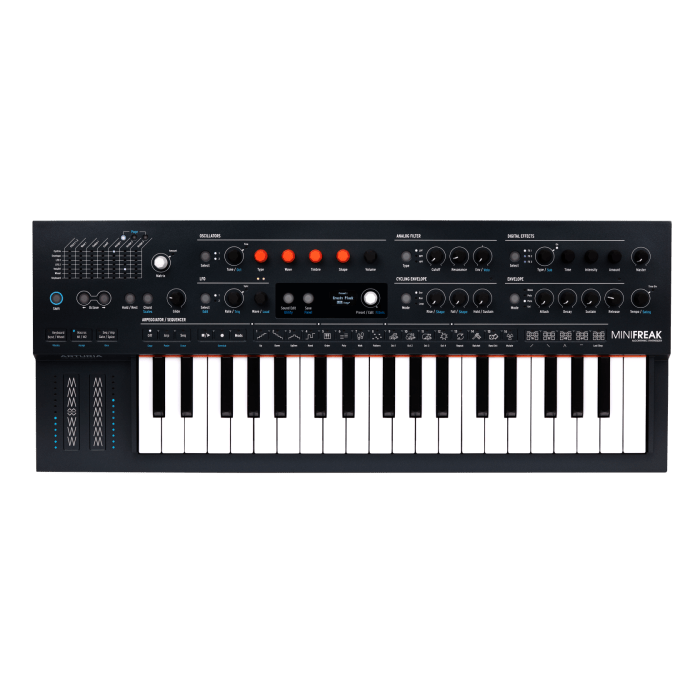
6-voice hybrid synth with 31 oscillator modes
Import your own samples and wavetables with firmware 5.0
granular synthesis, wavetable, FM, and analog filtering
vocoder, 64-step sequencer, and extensive Mod Matrix
includes MiniFreak V for hardware and DAW integration
Want to know when this item is back in stock? Send us your email address and we'll notify you as soon as it's available!
Our product experts are happy to help you!
The Arturia MiniFreak is a 6-voice hybrid synthesizer that combines two digital sound engines with polyphonic analog filters and VCAs. With 37 velocity-sensitive Slim-key keys with aftertouch, 31 oscillator modes, an extensive modulation matrix, three effects slots, a 64-step sequencer, and a performance arpeggiator, the MiniFreak is designed for both spontaneous playing and in-depth sound design.
Since its introduction, the MiniFreak has also been significantly expanded with (free) firmware updates. Granular synthesis and sample playback were added, followed by vocoder functions and, most recently, firmware 5.0. With this update, you can import your own samples and wavetables via MiniFreak V and then transfer them to the hardware. As a result, the current MiniFreak is a considerably more versatile instrument than it was at its original launch.
Two engines and 31 oscillator modes
At the heart of the MiniFreak are two digital engines per voice. These can be used independently of one another, but Engine 2 can also process the signal from Engine 1. This creates combinations that go beyond two traditional oscillators side by side. The 31 oscillator modes cover various forms of synthesis and sound processing. These include Virtual Analog, wavetable, FM, wave shaping, additive-style sounds, Karplus-Strong physical modeling, formant, speech, modal synthesis, noise, and granular synthesis. There are also sound engines derived from Mutable Instruments’ open-source technology and algorithms developed in collaboration with Noise Engineering. Engine 2 also includes modes that specifically focus on processing the output of Engine 1. These include filtering, comb filtering, distortion, and other ways to make the two engines interact with each other. This allows you to transform relatively simple oscillator settings into complex sounds without external effects or additional synthesizers.
Granular Synthesis and Sample Engine
With firmware 3.0, the MiniFreak gained an extensive collection of sample-based engines. In addition to a traditional Sample engine, seven granular engines are available: Cloud Grains, Hit Grains, Frozen, Skan, Particles, Lick, and Raster. The Sample engine can play, loop, and reverse samples. The granular engines go a step further by breaking a sample into small fragments and then reassembling, repeating, or manipulating them in terms of time and pitch. Cloud Grains focuses on clouds of small grains and layered textures. Hit Grains can use short fragments for rhythmic and percussive effects. Frozen freezes a section of the source material to create sustained sounds and pads. Skan moves through different parts of a sample and lends itself to time-stretch-like effects. Particles generates scattered sound particles, while Lick and Raster focus on rhythmic slicing, repeats, and glitch-like patterns. This allows the MiniFreak to be used not only for traditional synthesizer sounds but also for soundscapes, rhythmic textures, experimental effects, percussion, and dynamic sample-based sounds.
Firmware 5.0: Use Your Own Samples
With the free MiniFreak 5.0 update, it’s now possible to useyour own samples. This is done via MiniFreak V, where you can import, preview, and organize files before transferring them to the MiniFreak hardware. WAV, AIFF, and FLAC files are supported. MiniFreak V handles the conversion and can prepare the material for use in the Sample and granular engines. Samples are converted to 12-bit / 32 kHz and can be up to 6 seconds long. This means you’re no longer limited to the included sample material. Your own recordings, drums, field recordings, instruments, vocals, and other audio sources can be used as a starting point and then processed by the MiniFreak engines. The combination of your own samples with Cloud Grains, Frozen, Skan, Raster, and the other granular engines makes firmware 5.0 a major expansion, especially for sound design.
Importing Your Own Wavetables in
Firmware 5.0 also adds the ability to import your own wavetables. Wavetables from other libraries—including material used in Arturia Pigments, for example—can be imported into MiniFreak V and then used with the MiniFreak’s Wavetable engine. WAV, AIFF, and FLAC files are supported for wavetable import. Wavetables must be mono and are converted by MiniFreak V to 24-bit with 512 points. This allows you to build your own wavetable library and use the MiniFreak with sound material that goes beyond the standard built-in selection.
New Presets for Firmware 5.0
Firmware 5.0 also includes a new Factory Bank with 23 presets. These patches are built around the new capabilities for custom samples and wavetables and demonstrate how this material can be combined with the existing Freak engines, filters, modulation, and effects. The MiniFreak now features over 400 factory patches, covering a variety of synth sounds, pads, leads, basses, keys, percussive sounds, granular textures, and experimental sound design.
[[READMORE]]
Vocoder without a dedicated Vocoder Edition
Firmware 4.0 added vocoder functions to the MiniFreak. Two effects are available for this: Ext In Vocoder and Self Vocoder. With Ext In Vocoder, an external audio source can be processed via the audio input. A voice recorded through a suitable microphone setup, a drum machine, a synthesizer, or another audio signal can thus be used as a source for the vocoder. Self Vocoder does not require an external source. In this mode, the MiniFreak’s internal synthesizer signal is processed by the vocoder itself. This enables vocoder-like filtering, resonant sounds, and spectral effects without connecting a microphone. The standard MiniFreak also supports these vocoder functions after a firmware update. A microphone is not included with this version.
’sHybrid Architecture with True Analog Filters After passing through the digital sound engines, each voice is routed through a polyphonic analog filter and an analog VCA. This combination of digital oscillators and analog filtering forms the MiniFreak’s hybrid architecture. This allows you to combine various forms of digital synthesis with the response of an analog filter. This works for both traditional subtractive synth sounds and complex wavetable, FM, granular, and sample-based patches. The MiniFreak can be played in 6-voice polyphony, but also features a 12-voice paraphonic configuration, unison, and mono modes. This allows you to adapt the voice architecture to pads, chords, leads, basses, and unison sounds.
’sExtensive Modulation Matrix The Mod Matrix is a key component of the MiniFreak. The matrix features seven modulation sources and thirteen possible destinations. Various parameters of the engines, filters, effects, and other components can be linked to modulation sources. Two LFOs are available per voice. In addition, you get a standard envelope and a cycling envelope per voice. The LFO waveforms can be customized, so you’re not limited to fixed sine, triangle, or square waves. With the LFO Shaper, you can create more complex modulation shapes with multiple segments. This allows you, for example, to automatically modulate oscillator parameters, filters, effect settings, and other modulation destinations. Modulating modulation sources is also possible.
Spice & Dice
The well-known Freak features Spice & Dice are also included. These allow you to randomly generate variations in existing sequences and patterns in a controlled manner. Spice determines how much variation is added, while Dice can generate new variations. This makes the MiniFreak ideal for patterns that constantly change without requiring you to program every step manually. Especially when combined with modulation, granular synthesis, and the arpeggiator, this quickly yields new ideas.
64-step sequencer
The built-in sequencer has a maximum of 64 steps, spread across four pages of sixteen steps each. In addition to notes, four lanes of automated modulation can be recorded. This allows you to not only program melodies within a sequence but also capture changes to oscillator settings, filters, effects, and other parameters. The sequencer can also be edited while playing. Ratchets, octave shifts, randomization, and various performance functions make it possible to modify patterns live.
Performance Arpeggiator In addition to the sequencer, the MiniFreak features an arpeggiator with functions that go beyond a standard up/down arpeggiator. Ratchet, Octave Randomize, and other performance functions can be used while playing. The touch strips can be used for pitch bend and modulation, as well as for the MiniFreak’s macro and sequencing functions.
Three digital effects slots
The MiniFreak has three digital FX slots that can be used in insert or send configurations. There are currently 13 effect algorithms available. These include chorus, phaser, flanger, reverb, delay, distortion, Bit Crusher, 3-Band EQ, Peak EQ, Multi Comp, and Super Unison. With firmware 4.0, the Ext In Vocoder and Self Vocoder were added. Because three effects can be combined within a single patch, a sound can be finalized directly within the synthesizer—ranging from subtle stereo chorus and reverb to distortion, bit reduction, compression, and vocoder effects.
37 keys with aftertouch
The keyboard consists of 37 velocity-sensitive Slim-key keys with aftertouch. This allows a patch to respond to both the velocity of the keystroke and the pressure applied after a key is pressed. Aftertouch can be assigned to various parameters within the modulation matrix. For example, while playing, you can open a filter, add vibrato, or change an oscillator parameter without operating an additional controller.
Chord and Scale Mode
ChordMode allows you to trigger complete chords from a single key. In addition to the default settings, you can enter and save your own chord voicings. Scale Mode restricts the keyboard to a selected scale. The MiniFreak includes several preset scales and also supports custom settings. Chord Mode and Scale Mode can be used together, which is useful for chord progressions, sequences, and live performance.
MiniFreak V included
Upon registering the hardware, you gain access to MiniFreak V. This software version replicates the hardware’s architecture, including the digital engines and modeled analog filters. MiniFreak V can be used standalone or within a DAW. Presets can be exchanged between the software and hardware, and the hardware can be used to control MiniFreak V. With firmware and software version 5.0, MiniFreak V also plays a key role in managing and importing custom samples and wavetables. Content can be prepared on the computer and then transferred to the hardware. For users who utilize both hardware and software, this creates a unified workflow for programming, preset management, and custom sample and wavetable content.
Connections for Studio and Live Use
The MiniFreak features balanced stereo outputs and a separate headphone jack. External signals can be processed by the synthesis engine and vocoder via the audio input. MIDI in, out, and thru are available for connecting to other hardware. The MiniFreak also features clock in and clock out, allowing it to be synchronized with drum machines, sequencers, and modular equipment. The MiniFreak connects to a computer via USB for MIDI, MiniFreak V, preset management, updates, and transferring custom content. There is also a connection for a sustain pedal.
’sCompact Size Despite its extensive synthesis architecture, the MiniFreak remains compact. The unit measures 57.8 cm wide, 23.1 cm deep, and 5.5 cm high. It weighs 2.94 kg. As a result, it takes up relatively little space on a studio desk and is also easy to transport for rehearsals and live performances.
Included with t
The Arturia MiniFreak comes with MiniFreak V, a universal 12V/1A power adapter, a USB cable, and a registration card.
Arturia MiniFreak features:
- hybrid hardware synthesizer
- 6-voice polyphony
- 12-voice paraphonic mode
- mono and unison modes
- 37 velocity-sensitive Slim-key keys
- aftertouch
- two digital sound engines
- 31 oscillator modes
- Engine 2 can process Engine 1
- Virtual Analog synthesis
- FM synthesis
- wavetable synthesis
- Granular synthesis
- Sample playback
- Physical modeling
- formant and speech engines
- Mutable Instruments-based oscillator modes
- Noise Engineering-based engines
- Sample engine with loop and reverse functions
- seven granular engines: Cloud Grains, Hit Grains, Frozen, Skan, Particles, Lick, and Raster
- Import of custom samples starting with firmware 5.0
- Sample import via MiniFreak V
- Supported sample formats: WAV, AIFF, and FLAC
- Sample conversion: 12-bit / 32 kHz
- Maximum sample length: 6 seconds
- Import of custom wavetables starting with firmware 5.0
- Supported wavetable formats: WAV, AIFF, and FLAC
- Wavetable conversion: 24-bit / 512 points
- New Factory Bank 5.0 with 23 presets
- More than 400 factory presets
- 244 user preset slots
- Polyphonic analog filters
- analog VCAs
- one envelope per voice
- one cycling envelope per voice
- two LFOs per voice
- user-programmable LFO curves
- Mod Matrix with 7 sources and 13 possible destinations
- Spice & Dice randomization
- Chord Mode
- Scale Mode
- OLED display
- 64-step sequencer
- sequencer spread across 4 pages of 16 steps
- 4 lanes for automated modulation
- Performance arpeggiator
- Ratchet function
- Octave Randomize
- 3 digital FX slots
- Effect slots usable in insert or send mode
- 13 effect algorithms
- Audio input for external signals and vocoder use
- Balanced stereo outputs
- headphone output
- MIDI In
- MIDI out
- MIDI Thru
- USB port
- Clock In
- Clock out
- Sustain pedal jack
- includes MiniFreak V software
- Preset exchange between hardware and MiniFreak V
- Transfer your own samples and wavetables from MiniFreak V to the hardware
- includes 12V/1A power adapter
- includes USB cable
- Dimensions: 57.8 x 23.1 x 5.5 cm
- weight: 2.94 kg
| Brand | Arturia |
|---|---|
| Ean Code | 3760033531724 |
| No. of keys | 37 |
| Color | black |
| Touch sensitve | yes |
| Pedal included | no |
| Sequencer | yes |
| Sound Source | digital |
| Article number | 70179 |
Tutorials | MiniFreak - Overview
In this tutorial, Matt Pike takes you on a tour of the MiniFreak’s features, hidden capabilities, and unique sounds. Discover everything this 6-voice hybrid polysynth has to offer and how it defies traditional synthesizer conventions.

 Blog
Synthesizers zijn al decennialang een essentieel instrument in de wereld van elektronische muziek. Ze hebben een uniek geluid en bieden eindeloze mogelijkheden voor geluidscreatie. In deze blog duiken we dieper in de verschillende soorten synthesizers, hoe ze werken en hun interessante geschiedenis.
Read more in our blog