
Roland n/vision
synthesizer

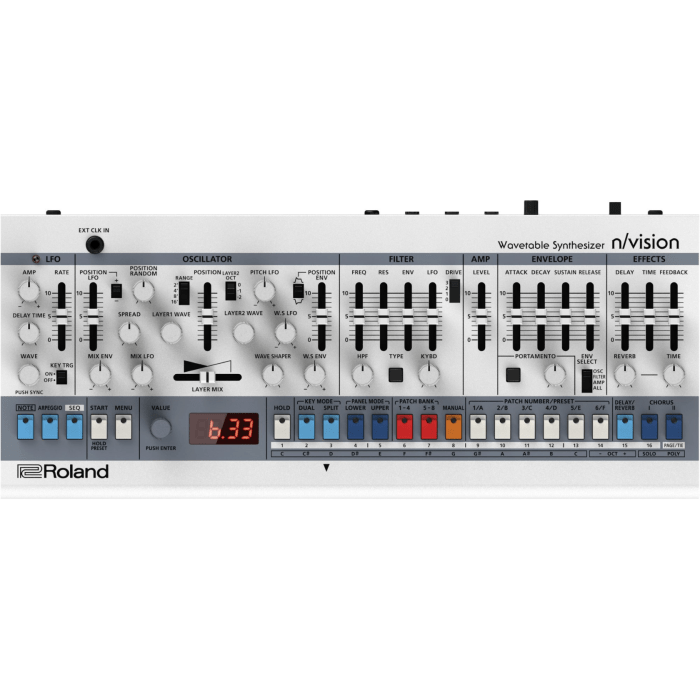
Wavetable synthesis with up to 56-voice polyphony
Two-layer wavetable engine with extensive modulation
Wave shaper and analog-modeled filters
64-step polyphonic sequencer and 17 MFX effect types
Includes K-25m keyboard and USB-C audio/MIDI
Klundertmusic.nl will come back on your offer within 1-2 working days
Want to know when this item is back in stock? Send us your email address and we'll notify you as soon as it's available!
Our product experts are happy to help you!
The Roland n/vision is a compact wavetable synthesizer from the Roland Boutique series that combines classic wavetable synthesis with modern Roland technology. With up to 56-voice polyphony, a two-layer wavetable engine, extensive modulation capabilities, wave shaping, and analog-modeled filters, this synthesizer offers extensive possibilities for sound design. From moving pads and complex digital textures to powerful leads, bass sounds, and experimental synthesizer tones.
The n/vision combines direct control via knobs and sliders with extensive settings for sound programming. Additionally, the instrument features a polyphonic 64-step sequencer, an arpeggiator, 17 effect types, and USB-C audio/MIDI. Thanks to the included K-25m keyboard, the built-in speaker, and the ability to run on batteries, you can use the Roland n/vision in the studio, on stage, and on the go.
Wavetable Synthesis with Extensive Sound Capabilities
The Roland n/vision useswavetable synthesis, a synthesis technique in which different waveforms within a wavetable are combined and cycled through. By changing the position within a wavetable, sound variations are created that can evolve as you play. This technique forms the basis for creating digital synthesizer sounds with moving overtones, changing textures, and complex harmonic structures. Combined with Roland’s sound technology, the n/vision features a comprehensive synthesizer architecture suitable for both classical and modern electronic music. Using the built-in controls, you can directly adjust the wavetable position, oscillator settings, filters, and modulation. This allows you to program sounds from scratch or further develop existing patches. The n/vision offers up to 56-voice polyphony, depending on the load on the sound generator. This gives you the flexibility to create expansive chords, layered sounds, and synthesizer parts with long envelopes.
’sTwo-Layer Wavetable Engine and Multitimbral Capabilities A key feature of the Roland n/vision is its wavetable engine with two separate layers. Within each part, you can combine two wavetable layers and edit them independently of each other. The Layer Mix control lets you adjust the balance between the two layers. The individual wavetable settings provide control over the waveforms, pitch, and position within the wavetable. The synthesizer also supports two-part multitimbral operation with separate Upper and Lower parts. Using the Dual and Split functions, you can combine sounds or distribute them across different sections of the keyboard. This allows you, for example, to combine a digital pad with a bass sound, layer two different wavetable textures, or assign a lead sound to one section of the keyboard. This architecture also offers possibilities for creating more complex synthesizer sounds. By applying different waveforms, modulations, and settings to the two layers, you can develop sounds that change as you play.
Wave Shaping for Additional Harmonics and Sound Processing
The Roland n/vision features a wave shaper that allows you to further process the waveforms. Wave shaping uses nonlinear signal processing to alter the shape of an incoming signal. This creates additional harmonics and timbral structures that aren’t determined solely by the original wavetable. This feature can be used to add more harmonic content to sounds, as well as to create sharper digital textures, distorted synthesizer sounds, and experimental effects. The Wave Shaper control lets you set the intensity of the processing. Additionally, modulation options are available that allow the wave shaping to change while you’re playing. This lets you, for example, make a synthesizer sound transition from a bright digital tone to a more complex, harmonically richer sound.
[[READMORE]]
Advanced Oscillator and Wavetable Modulation
In addition to its two-layer wavetable engine, the Roland n/vision offers extensive modulation capabilities. Various modulation sources can be assigned to parameters such as wavetable position, the balance between layers, pitch, and wave shaping. The oscillator section includes separate controls for Position LFO, Position Random, Position Envelope, Pitch LFO, and Wave Shaper modulation. The Position Random function allows you to add variation to the wavetable position. The Position Envelope allows you to vary the wavetable position according to an envelope curve. In addition, the synthesizer features a Spread control that lets you widen the stereo image of a sound. This allows you to give layered synthesizer sounds and pads a more spacious spread. The Layer Mix can also be modulated, causing the balance between the two wavetable layers to change while playing. These features give you control over the evolution of a sound, from subtle movement to extensive sound transformations.
Step LFO and Extensive Modulation Capabilities
The Roland n/vision features an LFO section and Step LFO functionality for creating rhythmic and dynamic modulations. With the LFO, you can modulate pitch, wavetable position, and other synthesizer parameters, among other things. The available settings provide control over the speed, intensity, and shape of the modulation. The Step LFO allows you to create modulation patterns with individual steps. This lets you add rhythmic movements and repeating parameter changes to synthesizer sounds. In combination with the envelopes, oscillator modulation, and wave shaper, you can develop sounds that continue to evolve as you play. For producers and sound designers, this offers possibilities for ambient textures, electronic effects, rhythmic synthesizer patterns, and experimental sounds.
Analog-modeled filters and vintage filter characters
The Roland n/vision combines digital wavetable synthesis with filter models inspired by classic synthesizers. The filter section features an analog-modeled filter with a Drive function and various filter types. This allows you to adjust the harmonic content of a sound and create different filter characters. Using the Cutoff and Resonance controls, you can determine which frequencies are passed and how strongly the frequencies around the filter cutoff are emphasized. In addition, the filter section includes settings for envelope modulation, LFO modulation, key tracking, and a separate high-pass filter. The Drive function lets you add extra saturation and harmonic distortion to the filter signal. This allows you to create both warm, analog-inspired synthesizer sounds and sharper digital sounds. The combination of wavetable synthesis and various filter characteristics makes the n/vision ideal for developing a wide range of sound textures.
17 effect types including JUNO chorus, delay, and reverb
The Roland n/vision features a built-in effects engine that lets you further process synthesizer sounds. There are 17 MFX effect types available, including the well-known Roland JUNO chorus effect. This lets you add the recognizable width and movement of classic Roland synthesizers to pads, strings, and other sounds. In addition to the MFX effects, separate delay and reverb effects are available. The delay section features controls for delay time and feedback, among other settings. This allows you to add repeats to melodies, arpeggios, and rhythmic synthesizer parts. The reverb section offers five reverb types and a Shimmer function. This function adds an octave-shifted timbre to the selected reverb effect, creating spatial and harmonic textures.
The effects engine offers the following processing options, among others:
- 3 chorus effects
- 4 delay effects
- overdrive
- fuzz
- drive
- bit crusher
- lo-fi compressor
- 2 phaser effects
- filter effect
- 2 pitch-shifter effects
- 5 reverb types with Shimmer function
With these effects, you can recreate the vintage character of classic synthesizers as well as create modern digital effects and atmospheric sounds.
64-step polyphonic sequencer with motion recording
The Roland n/vision features a built-in polyphonic step sequencer for programming basslines, chord progressions, and melodic patterns. This sequencer supports two separate parts and up to 64 steps. Up to eight notes per part can be programmed per step, allowing you to create both monophonic and polyphonic sequences. The sequencer also features motion recording. This lets you record changes in synthesizer parameters and incorporate them into a pattern. For example, you can capture changes in wavetable position, filter settings, or other sound parameters while a sequence is playing. This allows you to create patterns that not only change melodically but also constantly shift in timbre.
Arpeggiator for Rhythmic Patterns
In addition to the step sequencer, the Roland n/vision features an arpeggiator that lets you automatically generate note patterns based on the keys you play. This feature is ideal for creating electronic basslines, rhythmic synthesizer parts, and dynamic melodies. By combining the arpeggiator with wavetable modulation, filters, and effects, you can create patterns in which both the pitch and the timbre change. The Hold function allows you to hold notes and patterns while you edit the sound using the synthesizer controls.
Direct Control and Extensive Sound-Design Features
The Roland n/vision is designed for musicians who want to be able to adjust sounds directly. The control panel features separate sections for the LFO, oscillators, filters, amplifier, envelopes, and effects. The knobs and sliders provide direct access to key synthesizer parameters. The oscillator section includes controls for wavetable position, Layer Mix, Spread, wave shaping, and various modulation settings. In the filter section, you’ll find controls for frequency, resonance, envelope modulation, LFO, and filter type. The envelopes feature separate Attack, Decay, Sustain, and Release controls. Additionally, portamento settings are available for smooth transitions between played notes. For more advanced settings, the instrument features menu-driven functions accessible via the LED display and the Value control. The synthesizer offers memory capacity for 240 sound patches and 96 patterns. This allows you to save your own sounds and sequences and reuse them later.
USB-C Audio/MIDI and Connections for External Devices
The Roland n/vision is equipped with connections for integration with computers, MIDI hardware, and other electronic instruments. Via the USB-C port, the synthesizer functions as an audio/MIDI interface. This allows you to exchange audio and MIDI data with a connected computer and use the n/vision in combination with music software and a DAW. The traditional MIDI IN and MIDI OUT ports allow you to connect the synthesizer to an external MIDI keyboard, hardware sequencer, or other MIDI devices. In addition, the n/vision features an external clock input. This allows you to synchronize the instrument with compatible analog equipment, such as drum machines and other synthesizers. For audio connections, there is a stereo output, a stereo headphone jack, and a stereo MIX IN input. This allows you to use the Roland n/vision both on its own and as part of a larger synthesizer or production setup.
Compact Roland Boutique Design
The Roland n/vision is part of the Roland Boutique series and combines extensive synthesizer features with a compact enclosure. The instrument features a white finish with matching knobs, sliders, and side panels. The control panel is organized into separate synthesizer sections, making the most important parameters immediately accessible. Measuring 30.8 x 20.9 x 5.4 cm including the keyboard dock, the synthesizer takes up very little space on a desk or in a studio setup. The built-in speaker allows you to produce sound immediately without connecting an external amplifier or studio monitors. Additionally, the n/vision can be powered via USB-C or with four AA batteries. When using four rechargeable Ni-MH AA batteries with a capacity of 1900 mAh, the expected operating time is approximately six hours. Actual battery life depends on the batteries and usage conditions. Thanks to these power options, you can also use the synthesizer in locations where no AC power is available.
Includes Roland K-25m keyboard d
The Roland n/vision comes standard with the Roland K-25m keyboard dock. This compact keyboard with 25 touch-sensitive mini keys was developed for the Roland Boutique series and allows you to play the synthesizer module as a standalone instrument. The module can be inserted into the keyboard dock. Thanks to its tiltable design, you can position the control panel in various angles. This gives you a synthesizer with direct access to the controls and its own keyboard, without having to connect an external MIDI keyboard. The keyboard dock makes the n/vision suitable for use on a desk, in a mobile studio, or during live performances.
Who is the Roland n/vision designed for?
The Roland n/vision was developed for producers, sound designers, synthesizer enthusiasts, and electronic musicians seeking extensive capabilities for creating their own sounds. The combination of wavetable synthesis, two separate voice layers, extensive modulation, and wave shaping makes the instrument ideal for programming digital synthesizer sounds, moving pads, complex textures, and electronic effects. For musicians who prefer to work directly with synthesizer parameters, the n/vision offers a control panel with knobs and sliders. At the same time, extensive settings are available for users who want to delve deeper into the sound architecture. Thanks to the polyphonic sequencer, arpeggiator, and built-in effects, you can create complete synthesizer patterns without additional software. With USB-C audio/MIDI, traditional MIDI connections, and an external clock input, the instrument can be integrated into both a modern computer-based studio and a hardware-based synthesizer setup.
Roland n/vision features:
- compact Roland Boutique wavetable synthesizer
- wavetable synthesis combined with modern Roland sound technology
- up to 56-voice polyphony, depending on the load on the sound generator
- two-part multitimbral architecture
- Two separate wavetable layers per part
- Independent control of wavetable position and layer balance
- Dual and Split modes for combining and splitting sounds
- wave shaper for nonlinear waveform processing and additional harmonics
- Oscillator modulation for wavetable position, pitch, and wave shaping
- Position LFO and Position Envelope
- Position Random for variation in wavetable position
- Layer Mix control with modulation capabilities
- Spread control for widening the stereo image
- Step LFO for rhythmic modulation
- Various filter models inspired by classic synthesizers
- Analog-modeled filter with Drive function
- Adjustable filter frequency and resonance
- High-pass filter
- Filter modulation via envelope and LFO
- Key tracking for filter control
- ADSR envelope with separate Attack, Decay, Sustain, and Release controls
- Adjustable portamento
- 17 built-in MFX effect types, including Roland JUNO chorus
- 3 chorus effects
- 4 delay effects
- Separate delay and reverb controls
- 5 reverb types with Shimmer function
- polyphonic step sequencer with two parts
- up to 64 steps per sequence
- up to 8 simultaneous notes per step per part
- Motion recording for capturing parameter movements
- Built-in arpeggiator
- Hold function for sustaining notes
- 240 memory slots for sound patches
- 96 memory slots for patterns
- Direct control via knobs, sliders, and function buttons
- Additional menu-driven sound design functions
- 4-character 7-segment LED display
- Built-in speaker
- USB-C audio/MIDI interface
- MIDI IN and MIDI OUT connectors
- External clock input via 3.5 mm mono mini-jack
- 3.5 mm mini-jack stereo audio output
- Stereo headphone jack (3.5 mm mini-jack)
- Stereo MIX IN input via 3.5 mm mini-jack
- Powered by four AA batteries or USB-C
- Supports Ni-MH and alkaline batteries
- Battery life of approximately 6 hours when using 1900 mAh Ni-MH batteries
- 500 mA current draw when powered via USB
- Includes Roland K-25m keyboard dock with 25 touch-sensitive mini keys
- White housing with white side panels
- Dimensions including keyboard dock (W x D x H): 30.8 x 20.9 x 5.4 cm
- Weight including K-25m and batteries: 1.7 kg
- Roland product code: 428361A
The Roland n/vision comes with:
- Roland n/vision wavetable synthesizer module
- Roland K-25m keyboard dock
- 4 AA alkaline batteries (LR6)
- Quick Start Guide
- Safety instructions
- K-25m Keyboard Manual
Optional accessory: Roland DK-01 Boutique Dock
| Brand | Roland |
|---|---|
| Ean Code | 4957054524012 |
| Article number | 77017 |
| Size (product) | 5,4 cm x 30,8 cm x 20,9 cm |
| Size (packaging) | 45,5 cm x 8,5 cm x 36 cm |
Roland Boutique n/vision Wavetable Synthesizer | Alles wat je moet weten
The Roland n/vision brings wavetable synthesis to the compact Roland Boutique format. With two wavetable layers, extensive filter models, direct control, and advanced modulation capabilities, this synthesizer combines the character of classic digital synthesizers with modern sound-design features.
In this video, you’ll discover the Roland n/vision’s key sounds, effects, modulation capabilities, sequencer functions, and connections.

 Blog
Synthesizers zijn al decennialang een essentieel instrument in de wereld van elektronische muziek. Ze hebben een uniek geluid en bieden eindeloze mogelijkheden voor geluidscreatie. In deze blog duiken we dieper in de verschillende soorten synthesizers, hoe ze werken en hun interessante geschiedenis.
Read more in our blog