
Audient EVO 4 Start Recording Bundle
Studio starter pack

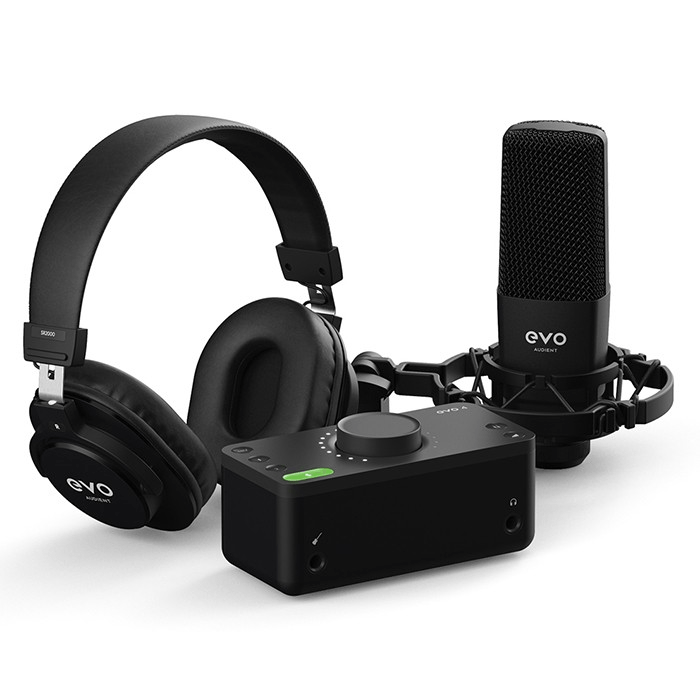
2 channel audio interface
Condenser microphone
Studio headphones
Ideal for starters in recording and livestreaming
Want to know when this item is back in stock? Send us your email address and we'll notify you as soon as it's available!
Our product experts are happy to help you!
Begin your journey into the world of audio recording with the EVO Start Recording Bundle (SRB), a professional, powerful and versatile home recording solution. With the EVO 4 audio interface, SR1 condenser microphone + shockmount, the SR2000 monitoring headphones and a balanced XLR cable.
With the Start Recording Bundle, you experience a combination of outstanding audio performance and innovative technology, allowing you to create studio-quality recordings from the start.
Combining industry-leading technical specifications with stunning performance and sound quality, the EVO 4 is the ultimate interface for beginners and professionals alike. Building on Audient's more than 20 years of experience in audio design, you get unparalleled audio quality on your desktop with the clean, warm and accurate EVO preamps - offering 58dB of gain range.
Capture everything perfectly with Smartgain Mode. Start playing, singing or talking and Smartgain automatically adjusts your microphone levels. USB Bus Powered (also for iOS), Ultra-Low Latency, Loopback (Podcasting). Perfect for beginners.
Meet your microphone, the SR1 - Capture every detail and nuance of your performance from the moment you press record with the SR1 condenser microphone. Its large aperture and versatile nature give you studio-quality recordings, no matter the source.
The SR2000 Monitoring headphones not only deliver superior audio performance but are also designed to provide long-lasting comfort. The 40mm Neodymium drivers consistently deliver accuracy and clarity where you need it most, helping you make the right sound decisions during recording and mixing.
EVO 4
- Microphone gain range: 58dB
- Line gain range: 58dB (-10dB pad)
- Phantom power: 48v +/-4v @ 10mA/channel
- Mic EIN: <-128dBu
- CMRR: >85dB @ 1kHz
- Maximum input level: +16dBu
- Input Impedance (Mic): >3kΩ balanced
- Input Impedance (Line): >10kΩ Balanced
- Frequency response: +/-0.5dB 10Hz to 40kHz
- Crosstalk: <-105dBu @ 1kHz & 10kHz
- THD+N @ 0dBu (1kHz): <0.0015%
- SNR: 100dB
- XLR: Pin 2 (Hot), Pin 3 (Cold) & Pin 1 (Shield)
- 1/4" Jack: TIP (Hot), RING (Cold) & SLEEVE (Shield)
EVO SR1 Condenser Microphone
- Element 14mm electronic condenser capsule
- Polar Pattern Uni-directional (Super-cardioid)
- Frequency Range 20Hz-18kHz
- Sensitivity 30dB±3dB (0dB=1V/Pa at 1kHz)
- Output impedance 150Ω±30% (at 1kHz)
- Load impedance ≥1000Ω
- Self noise 16dB A
- Max. Input SPL 134dB (at 1kHz ≤1% T.H.D)
- S/N ratio 78dB
- Phantom power supply 5V or 48V
- Electric current 3mA
EVO SR2000 Monitoring Heaphones
- Working principle Closed
- Mode Supra-aural
- Transducer type Dynamic
- Loudness 40MM
- Impedance 32ohm
- Sensitivity/ Max. SPL 95±3dB/105±3dB
- THD <0.3%
- Frequency Range 15HZ-22KHZ
- Max. Power 400MW
- rated Power 250MW
- Cable Type Straight
- Cable Length About 3M (straight)
- Plug 3.5MM+6.3MM
- Net weight 233g (with cable)
- Normal headband pressure Approx.2.8N
| Brand | Audient |
|---|---|
| Ean Code | 5060374260412 |
| Number of mic inputs | 2 |
| Number of line inputs | 2 |
| Number of instrument inputs | 2 |
| Aantal line outputs | 2 |
| Number of headphone outputs | 1 |
| Phantom power | yes |
| Number of ADAT Connectors | not applicable |
| Number of AES/EBU Connectors | not applicable |
| Number of MADI Connectors | not applicable |
| USB Bus-Powered | yes |
| Incl. power supply | no |
| Number of S/PDIF Connectors | not applicable |
| Article number | 74498 |

 Blog
Blog
Weg is de tijd dat het producen en opnemen van een nummer alleen voor professionele studio’s is weggelegd. Weg is de tijd dat een audio signaal eerst op tape geprint moest worden en later weer vier keer gebounced om een volledige mix te krijgen. Audio interfaces zijn tegenwoordig de normaalste zaak van de wereld, maar wat doet zo`n ding nou precies? Om het allemaal wat duidelijker te maken gaan we hier eens wat dieper op in.
Read more in our blog